
Three things we’re reading this month, all of which are worth your time, especially if you spend your days thinking about children, learning, and screens like we do.
Rebooting Childhood: How to Balance Screen Time, Build Relationships, and Help Kids Thrive
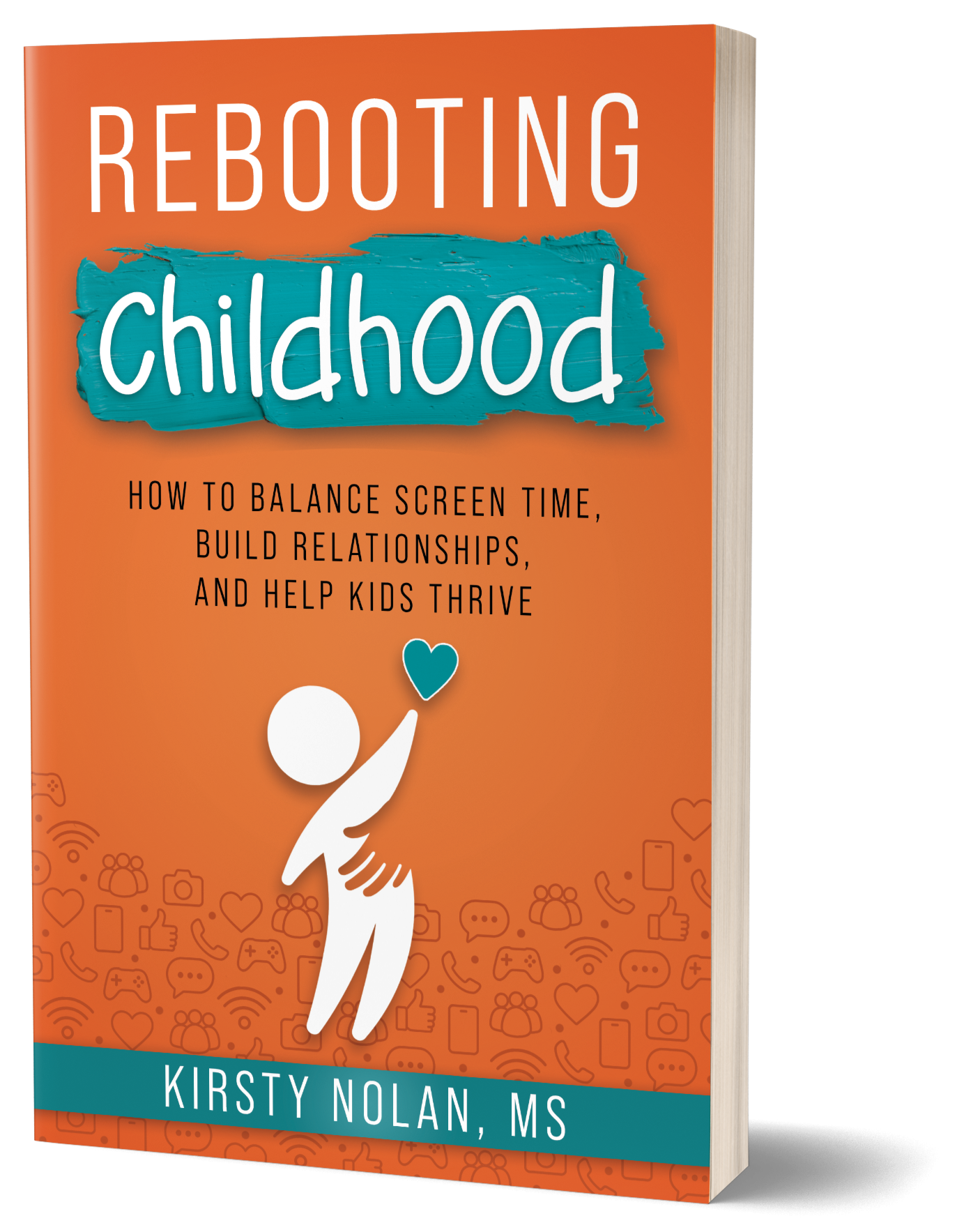
Nolan, K. (2026). Rebooting childhood: How to balance screen time, build relationships, and help kids thrive. Chaddock
Since 2014, Nolan has served children and families at Chaddock Attachment and Trauma Services (which is based in Quincy, Illinois). She is also the host of Chaddock’s Attachment Theory in Action podcast.
This is her first book, which she said she wrote for “anyone that is raising or caring for a child or young person, as well as those who support families in their work, who want to find ways to balance screen time while preserving healthy connections.”
The book is structured to be accessible and deeply informative. The first part covers developmental milestones, the second part is full of scripts and strategies ready to use, all based on the developmental stage of the child (and the adult!). If you need a solution before dinner, you can find it quickly here.
“If you’re looking for guidance that speaks to your experiences and offers actionable solutions, “Rebooting Childhood” is the perfect companion on your journey.”
- Gary M Blau, Ph.D., Former Senior Advisor for Children, Youth, and Families at the federal Substance Abuse and Mental Health Services Administration (SAMHSA)
This book’s message and accessible framing align closely with the principles behind ThinkPlayful™, both with clear supports for intentional connection at the core and an eye for meeting families where they live and play.
Next we dig deeper in an interview with the author. Stay tuned!
“Play vs. (?) ‘The Science of Math’: A Dialectical Synthesis for Early Mathematics Teaching”
Clements, D. H., & Sarama, J. (2026). Play vs. (?) “The Science of Math”: A dialectical synthesis for early mathematics teaching. Frontiers in Education, 11, Article 1805141. https://doi.org/10.3389/feduc.2026.1805141
Clements and Sarama take on the “false dichotomy” of whether early math should be taught through play or through direct instruction.
The article is an even-handed and thorough look at the evidence around how children best learn math. It summarizes both what "direct instruction" accomplishes (specific skill-building, particularly for children entering with less prior knowledge), AND shows where the evidence runs out. It does the same for "free play" (preschoolers naturally practice math skills during free play), AND yet free play on its own does not move children toward mathematical goals.
They distinguish free play, scaffolded play, guided play, and playful intentional activities, each with a different adult role and a different evidence base. Guided play, where the adult holds a learning goal but the child keeps meaningful agency, is a key driver of math learning.
This is the clearest statement we have seen of the design principles we use to build the ThinkPlayful™ app. There is a place for free play and for direct instruction … but both fall short without the essential ingredient of guided play!
“How Schools Can Help Parents Manage Kids’ Screen Time”
Prothero, A. (2026, July 21). How schools can help parents manage kids’ screen time. Education Week. https://www.edweek.org/leadership/how-schools-can-help-parents-manage-kids-screen-time/2026/07
Districts have worked to ban cellphones and limit classroom device time. What children do on screens at home affects how ready they are to learn the next day, yet educators have little control over those hours.
And there’s an important point here: Screen management cannot fall entirely on families. The American Academy of Pediatrics has moved toward more flexible guidance (because strict limits places all responsibility on families to solve what is a society-wide problem). One family was quoted wanting their school to state a norm out loud, so that no one family is facing the task alone. Those of us at ThinkPlayful who are parents feel this need too!
Our educator partners navigate this daily, and school-supported community norms feel like a good start. This is a problem that none of us can tackle and solve alone.
ONE MORE THING: Common Sense Media’s family tech planners are a free tool for building a household media plan tailored to children’s ages and The American Academy of Pediatrics resources for parents are good places to start.
“What We're Reading” is an occasional series by ThinkPlayful team members. Have something we should be reading and sharing? Let us know at thinkplayful.com/contact!